
What Is the 17c Formula?
The 17c formula is a method for calculating inherent diminished value — the permanent reduction in a vehicle's market value after an accident and repair. It was named after Exhibit 17-C in the 2001 Georgia case State Farm Mutual Auto Insurance Co. v. Mabry.
Since that ruling, the 17c formula has become the standard calculation method used by State Farm, GEICO, Progressive, Allstate, and virtually every major insurer in the United States when processing diminished value claims.
The 17c Formula: Step by Step
The 17c Formula
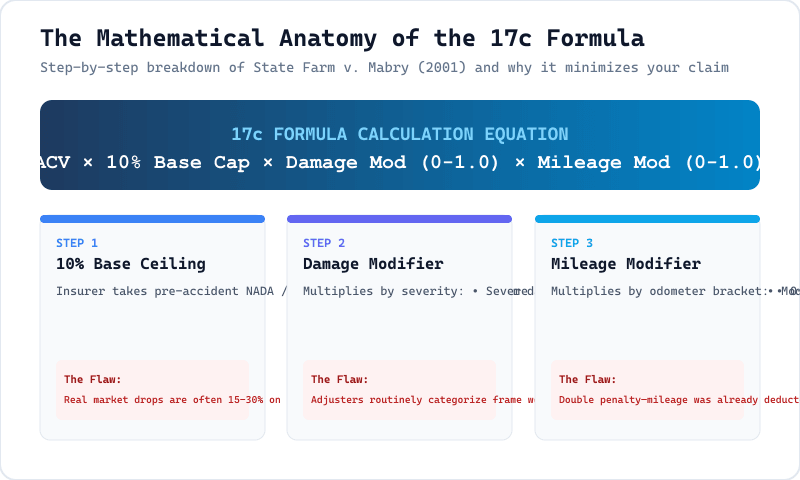
Step 1: Base Loss of Value (10% Cap)
The base loss is calculated as 10% of the vehicle's pre-accident Actual Cash Value (ACV). This is the first limitation: regardless of how severe the damage was, the starting point is capped at 10% of ACV. For a $30,000 vehicle, that's $3,000 — before the multipliers further reduce it.
Step 2: Damage Multiplier
| Damage Category | Multiplier | Description |
|---|---|---|
| 0 — No structural damage | 0.00 | Paint/cosmetic only |
| 1 — Minor damage | 0.10 | Minor dents, no structural |
| 2 — Moderate damage | 0.25 | Multiple panels, minor mechanical |
| 3 — Major damage | 0.50 | Major panel/structural components |
| 4 — Severe structural | 0.75 | Frame/structural members affected |
| 5 — Severe structural + deployment | 1.00 | Maximum — airbags deployed, severe frame damage |
Step 3: Mileage Multiplier
| Odometer Range | Multiplier |
|---|---|
| 0 – 19,999 miles | 1.00 |
| 20,000 – 29,999 miles | 0.80 |
| 30,000 – 39,999 miles | 0.60 |
| 40,000 – 49,999 miles | 0.40 |
| 50,000 – 59,999 miles | 0.20 |
| 60,000 – 69,999 miles | 0.00 |
| 70,000+ miles | 0.00 |
The Mileage Trap
Any vehicle with 60,000+ miles gets a multiplier of 0.00 — meaning the formula produces $0 in diminished value, regardless of how severely damaged and repaired the vehicle was. Market research shows this is demonstrably false. A well-maintained 80,000-mile vehicle still loses thousands in market value after an accident.
A Real 17c Formula Example
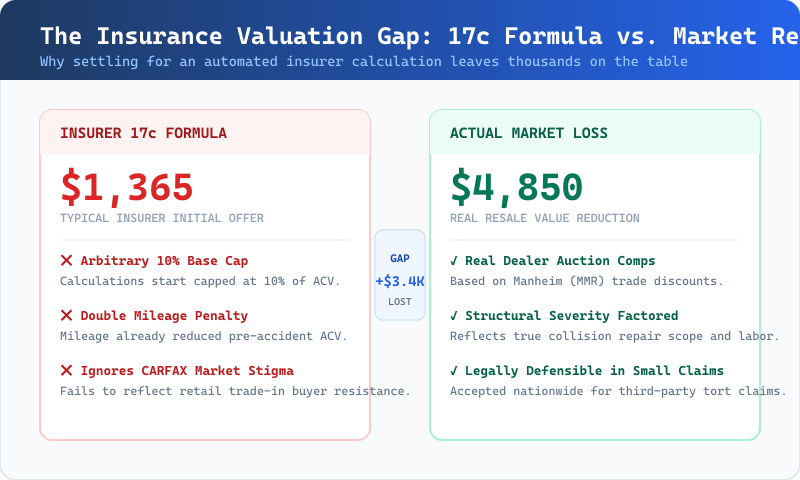
Let's say you drive a 2021 Toyota Camry with 45,000 miles. Pre-accident ACV: $24,000. Repair cost: $9,500. Structural damage (airbag deployment).
The insurer offers you $960. But market research on comparable Camry sales shows that a 2021 Camry with a disclosed major accident history sells for $3,000–$4,500 less than a clean-title equivalent. That's $2,000–$3,500 the formula is hiding from you.
Why the 17c Formula Undervalues Your Loss
- The 10% cap is arbitrary. There is no market data justification for capping base loss at 10% of ACV. High-demand vehicles and luxury brands often lose 20–30% in real-world market value after major accidents.
- The mileage table was created in 2001. Vehicle lifespans have increased dramatically since then. A 70,000-mile vehicle in 2024 is not worthless in the market — but the formula treats its accident history as having zero impact.
- It ignores brand prestige. A Tesla or BMW with an accident history loses a much higher percentage than a Honda Fit — the formula treats all vehicles identically.
- It doesn't account for local market conditions. Vehicle values vary significantly by region. The formula applies nationally without regional adjustment.
How to Challenge the 17c Formula
Courts in Georgia, California, Texas, North Carolina, and many other states have accepted market-based evidence to override or supplement the 17c result. The most effective approach:
- Get a professional DV report showing both the 17c result AND the market-based estimate
- Pull comparable listings (AutoTrader, CarGurus, Cars.com) showing the price gap between clean-title and accident-history vehicles
- Send a formal demand letter citing both methods and the documented gap
- If the insurer refuses, cite the specific court case in your state that accepts market evidence
Frequently Asked Questions
- What is the 17c formula for diminished value?
- The 17c formula calculates DV as: Base Loss (ACV × 10%) × Damage Multiplier × Mileage Multiplier. It comes from the 2001 Georgia case State Farm v. Mabry and is widely used by insurers.
- Why do insurers use the 17c formula?
- It caps base loss at 10% of ACV and applies mileage multipliers that often reduce payouts — especially above 60,000 miles under standard tables.
- Can I challenge the 17c formula?
- Yes. Many claimants present supplied inputs and calculation limitations or appraisals showing a larger loss. Whether that overrides 17c depends on state law and your documentation.
- Does 17c apply in every state?
- Insurers may offer 17c math nationwide, but courts do not treat it as binding everywhere. Check your state guide and use market evidence where allowed.
Sources & further reading
Statutes, claim rules, and settlement amounts depend on your state and facts. Use these references for methodology and history — not as legal advice.
Disclaimer: This content is for informational purposes only and does not constitute legal advice. The 17c formula application varies by state and insurer. Consult a licensed attorney or certified vehicle appraiser for guidance specific to your situation.