
Why You Need a Written Demand Letter
Calling your adjuster and asking them to "pay for the diminished value" rarely works. Verbal requests aren't documented, they're easy to ignore, and they don't signal that you'll escalate if ignored.
A formal written demand letter accomplishes several things:
- Creates a paper trail that can be used in arbitration, small claims court, or regulatory complaints
- Demonstrates that you've calculated your loss and know your rights
- Sets a clear deadline for response (which triggers insurer obligations under state regulations)
- Forces the adjuster to escalate to a supervisor who has authority to actually pay
Two Letters You Need: Demand vs. Counter-Offer
Letter 1: The Demand Letter (Initial Claim)
Sent after repairs are complete, the demand letter is your formal first claim. This is the letter that starts the clock.
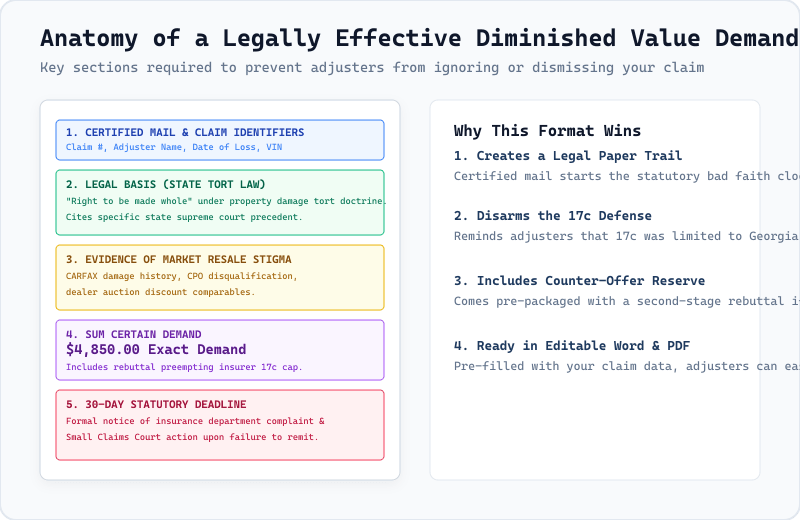
What to Include in Your Demand Letter
- Your contact information and the date
- Insurer details: company name, claims address, claim number, adjuster name
- Vehicle identification: year, make, model, VIN, pre-accident mileage
- Accident summary: date, location, brief description, police report number
- Pre-accident ACV: state the amount and your source (KBB, NADA, CarGurus)
- Repair cost: total repair amount from the final invoice
- Diminished value amount: your calculated claim — both 17c and market-based
- Documentation list: list all attachments (police report, repair invoice, photos, comparable sales, your DV report)
- Response deadline: typically 30 days
- Your signature and statement that this is a formal demand
Sample Demand Letter Opening
[Your Name]
[Your Address]
[Date]
[Claims Adjuster Name]
[Insurance Company]
[Claims Address]
RE: Diminished Value Claim — Claim #[XXXXXX] — [Year Make Model, VIN]
Dear [Adjuster Name],
I am writing to formally claim diminished value compensation resulting from the accident on [DATE] in which your insured, [AT-FAULT DRIVER NAME], was determined to be at fault per police report #[NUMBER].
Despite complete repairs to my [YEAR MAKE MODEL], the accident is now permanently documented in the vehicle's history report, reducing its market value. I am entitled to compensation for this inherent diminished value under [STATE] law.
Based on my calculations using both the industry-standard 17c formula and comparable market sale data, I am claiming $[AMOUNT] in diminished value. Supporting documentation is attached.
Please respond in writing within 30 days of receipt of this letter.
This is a template excerpt. Your actual letter should be customized with your specific vehicle data and claim details.
Letter 2: The Counter-Offer Letter
When the insurer responds with a lowball offer (which they will), your counter-offer letter formally rejects their number and states your counter-demand backed by specific evidence.
Key elements of an effective counter-offer letter:
- Acknowledge their offer (without accepting or thanking them for it)
- State clearly that you are rejecting their calculation
- Explain specifically why the 17c formula understates your loss in your case
- Cite 3–5 comparable vehicle listings showing the actual market price gap
- State your counter-demand amount with supporting documentation
- Set a new deadline and state you will escalate to the state Insurance Commissioner if not resolved
Key Tips for Effective DV Letters
Do
- Keep your tone professional and factual — not emotional or threatening
- Be specific about amounts, dates, and claim numbers
- Attach everything — the more documentation, the harder to dismiss
- Send via certified mail with return receipt (or email with read receipt AND certified mail)
- Keep copies of everything
- Reference your state's DV case law if applicable (see our state guides)
Don't
- Accept or sign anything until you've received full compensation (including DV)
- Make threats you're not prepared to follow through on
- Exaggerate your claim — it undermines your credibility
- Wait too long — most states have 2–5 year statutes of limitations
- Rely on verbal agreements — everything in writing, always
When to Get Your Letters Generated Professionally
Writing an effective demand letter that hits all the right points and cites the right evidence is time-consuming and easy to get wrong. Our letter generator ($19) produces:
- A complete demand letter pre-filled with your vehicle data, calculated DV, and proper legal language
- A counter-offer letter ready to send after the insurer's first response
- Both in DOCX (editable if you need to customize) and PDF format
Frequently Asked Questions
- When should I send a diminished value demand letter?
- Usually after repairs are complete and the accident is on vehicle history, so your amounts and attachments are final.
- Should I send the demand letter by certified mail?
- Certified mail or email with read receipt plus mailing creates a proof trail. Keep copies of everything.
- What is a counter-offer letter?
- It rejects the insurer's first number, explains why (often 17c vs market), and states your counter-demand with attached comps.
- How long should I give the insurer to respond?
- 30 days is common in templates; some states set adjuster response rules — see your state guide and NAIC complaint options if they stall.
Sources & further reading
Statutes, claim rules, and settlement amounts depend on your state and facts. Use these references for methodology and history — not as legal advice.
Disclaimer: Letter templates are provided for informational purposes. They are not legal advice and do not constitute attorney-client communication. For complex claims or significant amounts, consult a licensed attorney.