The Big Three Insurers and Diminished Value
State Farm, GEICO, and Progressive together write more than 50% of personal auto policies in the United States. While each has distinct claims procedures, their handling of third-party property damage diminished value claims follows a nearly identical corporate playbook:
- Do not volunteer information about diminished value to the claimant.
- Deny verbally first if the claimant asks loosely over the phone.
- If pressed in writing, run the 17c formula or proprietary claims matrix to make a token lowball offer.
- Wait to see if the claimant folds or accepts the check.
Carrier-by-Carrier Breakdown
1. State Farm Diminished Value Claims
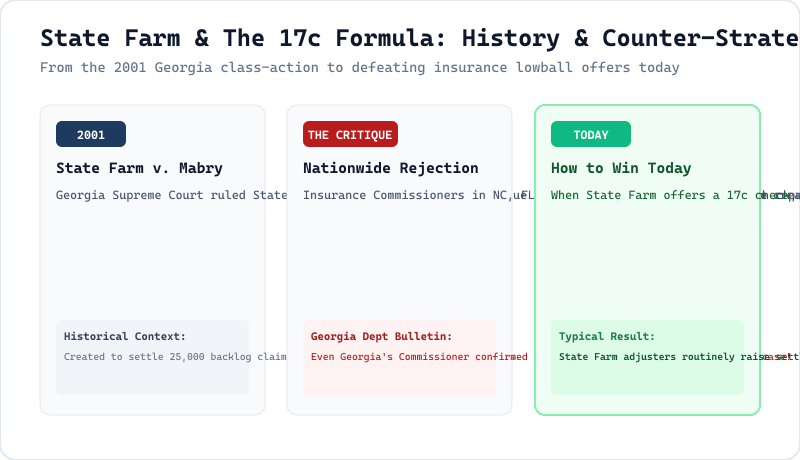
State Farm was the defendant in the 2001 Georgia case State Farm v. Mabry, where the "17c formula" label originated.
- Standard Tactic: State Farm adjusters frequently rely on 17c nationwide, even in states where 17c has never been adopted by law or court precedent.
- Weakness: State Farm is heavily regulated and sensitive to formal written demand packages accompanied by actual dealer comparable sale sheets.
2. GEICO Diminished Value Claims
GEICO handles a high volume of claims and relies heavily on fast settlement metrics.
- Standard Tactic: GEICO claims representatives often argue that if vehicle repairs were completed at one of their "Auto Repair Xpress (ARX)" network shops, no diminished value exists because repairs carry a lifetime warranty.
- Counter-Argument: A repair warranty guarantees against peeling paint or bad welds; it does NOT remove the permanent accident record from CARFAX or salvage databases!
3. Progressive Diminished Value Claims
Progressive employs specialized property damage adjusters who frequently demand third-party appraisals or proof that you have attempted to sell or trade the vehicle.
- Standard Tactic: Requesting unrealistic proof of sale or claiming you cannot prove diminished value until you actually sell the vehicle ("unrealized loss").
- Counter-Argument: In virtually every state with established tort law, inherent diminished value occurs at the time of the accident and repair. You do NOT have to sell your car to prove loss of market value!
The 4-Step Playbook to Beat Lowball Offers
Never Settle the Property Claim on the First Offer
The first offer is an automated baseline designed to test your resolve.
Send Everything in Certified Writing
Phone conversations with adjusters have zero evidentiary value. Demand and counter-offer letters create a discoverable file.
Provide Real Comparable Market Sales
Show identical cars sold with clean titles vs. previous collision records. Real numbers beat arbitrary formula caps.
Cite State Insurance Regulations
Remind the adjuster of statutory response deadlines (typically 15 to 30 days) and state unfair claim practice statutes.
Frequently Asked Questions
- Does State Farm pay diminished value on third-party claims?
- When you are not at fault, you may demand DV from the at-fault carrier, including State Farm, subject to state law and documentation.
- Why does GEICO say repair warranty means no DV?
- A repair warranty covers workmanship, not CARFAX stigma. Market loss from accident history is separate from paint or panel warranties.
- What if Progressive says DV is unrealized until I sell?
- Many states treat inherent DV as occurring when the vehicle's market reputation changes after the crash and repair — cite comps, not future sale dates.
- What is the best way to counter a low 17c offer?
- Send a written demand with market listings, your calculator results, and a clear deadline; escalate via state insurance complaints if ignored.
Sources & further reading
Statutes, claim rules, and settlement amounts depend on your state and facts. Use these references for methodology and history — not as legal advice.
Disclaimer: State Farm, GEICO, and Progressive are registered trademarks of their respective owners. DVReport is an independent informational resource and is not affiliated with or endorsed by any insurance carrier.