
The Core Legal Question: Who Owns the Car?
When you lease a vehicle, the leasing finance company (e.g., Honda Financial Services, Ally, GM Financial, BMW Financial) holds the title to the vehicle. You are the lessee with contractual rights to possess and operate the vehicle.
Because diminished value represents property damage loss, insurance companies often use this ownership structure as an excuse to immediately deny your claim with the excuse: "You don't own the vehicle, so you have not suffered a financial loss."
That statement is only half true. Here is how it actually works depending on what you do at the end of your lease.
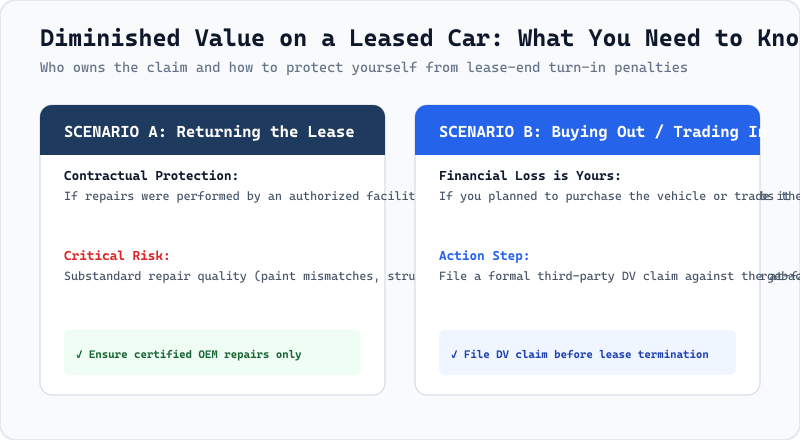
Scenario A: You Return the Vehicle at Lease End (Walk Away)
If your vehicle is repaired to certified manufacturer specifications and you turn in the keys at lease expiration:
- The Good News: Most standard closed-end leases (the typical consumer lease) do not charge you for diminished value if the vehicle was repaired properly with OEM-certified parts. The residual value was guaranteed in your contract.
- The Bad News: The leasing bank absorbs the diminished value at auction. Therefore, any third-party DV settlement technically belongs to the leasing company, not you.
- The Exception: If the inspector notes frame damage, structural repair, or poor paint blend during the lease-end inspection, they may bill you for excess wear-and-tear or substandard repairs. In that situation, you have direct out-of-pocket loss to recover from the at-fault insurer!
Scenario B: You Had Positive Lease Equity (Trade-in or Early Buyout)
In today's used car market, many lessees don't turn cars in — they trade them in to dealerships or sell them to CarMax/Carvana to pocket thousands in positive lease equity.
If your leased car is in an accident:
- The accident now appears on the CARFAX report.
- Your trade-in valuation drops by $3,000 to $8,000.
- Your positive equity is completely wiped out.
Under tort law in multiple states, the loss of positive equity is a measurable, compensable economic damage caused directly by the at-fault driver.
Scenario C: You Plan to Buy Out the Lease (Lease Purchase)
If you decide to exercise your contractual purchase option at lease maturity:
- You pay the pre-determined residual value agreed to before the accident (e.g., $24,000).
- You now own a vehicle that has suffered real diminished value (worth only $19,000).
- You have personally absorbed 100% of the diminished value loss.
In this scenario, once title transfers to you, you have undisputed standing to claim full diminished value from the at-fault driver's insurance company within your state's statute of limitations.
Action Steps for Leased Car Accidents
- 1.Insist on OEM Parts Only: Never allow aftermarket or salvage parts. Non-OEM parts violate your lease agreement and guarantee turn-in penalties.
- 2.Calculate the Diminished Value Immediately: Know the dollar impact on the vehicle's market value.
- 3.Get Written Confirmation on Lease-End Liability: Request your leasing bank's written policy regarding repaired collision damage.
- 4.Evaluate Lease Buyout Strategy: If the car lost heavy value, do NOT buy it out. Let the leasing company take the loss when you hand them the keys!
Frequently Asked Questions
- Can I claim diminished value on a leased car?
- Sometimes — it depends on who suffers the economic loss (you vs lessor) and whether you return, buy out, or trade the vehicle.
- Who gets the DV check if I return the lease?
- If you walk away under a standard closed-end lease with proper repairs, the lessor may absorb auction loss; you may still recover excess wear charges in some cases.
- What if I lose positive lease equity after an accident?
- If trade-in value drops because of accident history, that lost equity may be compensable in some states — document before-and-after quotes.
- When should I buy out a leased car after a crash?
- If DV is large, buying out at a fixed residual can leave you holding the loss. Compare market value, residual, and projected DV before deciding.
Sources & further reading
Statutes, claim rules, and settlement amounts depend on your state and facts. Use these references for methodology and history — not as legal advice.
Disclaimer: This article is for educational purposes only and does not constitute formal legal counsel. Lease agreements vary significantly. Review your specific contract language and consult a licensed attorney.