
What is a Diminished Value Claim?
A diminished value (DV) claim is a formal demand for compensation for the reduction in your vehicle's market value caused by its accident history. Even after a perfect repair, your car is worth less than a comparable vehicle that has never been in an accident — and you have the right to be compensated for that difference.
In most states, DV claims are filed against the at-fault driver's liability insurance, not your own insurer. Georgia is the main exception, allowing first-party claims as well.
Step-by-Step: Filing Your DV Claim
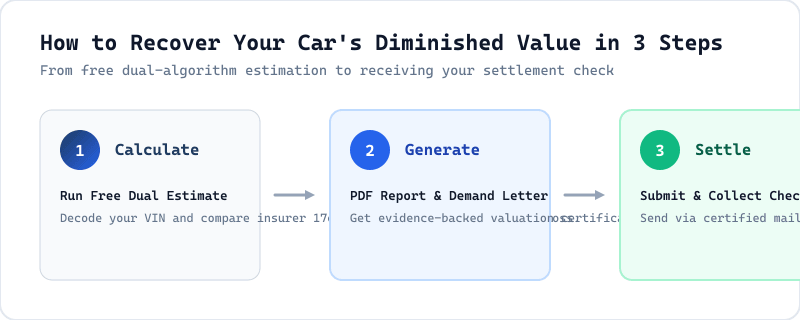
Step 1 — Calculate Your Diminished Value (Before You Do Anything Else)
Before contacting the insurer, know your number. Use our free calculator to get:
- The 17c formula result (what they'll offer)
- The market-based estimate (what you actually lost)
- The gap between them (your negotiating room)
Step 2 — Gather Your Documentation
The strength of your claim is proportional to your documentation:
- Police report — establishes fault and accident facts
- Repair estimate and final invoice — shows damage severity
- Before/after photos — visual documentation of damage
- CARFAX or AutoCheck report — proves the accident now appears on the vehicle history
- Comparable listings — 3–5 same-year/make/model vehicles with clean vs. accident history to show the market price gap
- All correspondence with the at-fault insurer — keep everything in writing
Step 3 — Send a Formal Demand Letter
A verbal request is easy to ignore. A formal written demand letter creates a paper trail and signals that you're serious. Your demand letter should include:
- Your name, address, and contact information
- The at-fault insurer name, claim number, and adjuster name
- Vehicle description (year, make, model, VIN)
- Pre-accident ACV and source (KBB, CarGurus, NADA)
- The DV amount you are claiming and your calculation method
- A deadline for response (typically 30 days)
- A list of attached documentation
Step 4 — Respond to the Counter-Offer
Expect one of three responses:
- Outright denial — "Your policy doesn't cover diminished value" or "We don't recognize DV claims." This is often wrong. See escalation below.
- Low 17c offer — They calculate using the formula and offer a fraction of market value. Counter with your market-based evidence.
- Reasonable counter — They acknowledge the claim but offer less than you demanded. Negotiate from your documented position.
Send a written counter-offer letter that cites the specific market evidence supporting your original demand. Don't accept the first counter — it's almost never their final position.
Step 5 — Escalate if the Insurer Refuses
If the insurer continues to deny or refuses to negotiate in good faith:
- File a complaint with your state's Department of Insurance (NAIC consumer portal). Insurers often respond to regulatory complaints.
- Consult an attorney who handles property damage or insurance bad faith claims. Many work on contingency for DV cases.
- Small claims court — for claims under $10,000–$15,000 (varies by state), this can be effective without an attorney.
- Hire an independent appraiser — a certified vehicle appraisal from an NAAA or IADA member carries significant weight in disputes.
Common Insurer Tactics (and How to Counter Them)
State-Specific DV Claim Rules
Your rights vary significantly by state. See our state guides for specific statutes of limitations, first-party vs. third-party rules, and key court cases:
Frequently Asked Questions
- Who do I file a diminished value claim against?
- In most states, you demand payment from the at-fault driver's liability carrier as a property damage claim. First-party claims against your own policy are limited — see your state guide.
- When should I send a diminished value demand letter?
- Usually after repairs are finished and the accident appears on vehicle history, so you can document severity, cost, and market loss with final numbers.
- Do I need an attorney for a diminished value claim?
- Many smaller claims are handled with documentation and negotiation. For larger amounts or bad-faith denials, consult an attorney or certified appraiser in your state.
- What if the adjuster cites the 17c formula only?
- Respond in writing with market comparables and your calculation. In several states, courts and juries weigh market evidence more heavily than 17c alone.
- Can I complain if the insurer ignores my demand?
- You can file a complaint with your state insurance department. The NAIC maintains a directory of state regulators for consumer complaints.
Sources & further reading
Statutes, claim rules, and settlement amounts depend on your state and facts. Use these references for methodology and history — not as legal advice.
Disclaimer: This content is for informational purposes only and does not constitute legal advice. DV claim rights vary by state and individual circumstances. Consult a licensed attorney for guidance specific to your situation.