
Defining Inherent Diminished Value
Inherent diminished value refers to the loss of market value tied to a documented accident history on services such as CARFAX, AutoCheck, or NMVTIS.
The core assumption of inherent diminished value is that:
Even when the vehicle has been repaired using original equipment manufacturer (OEM) parts to the highest structural and cosmetic standards, it is worth less on the open market than an identical undamaged vehicle.
The Three Types of Diminished Value
In auto insurance and tort law, there are three distinct categories of diminished value:
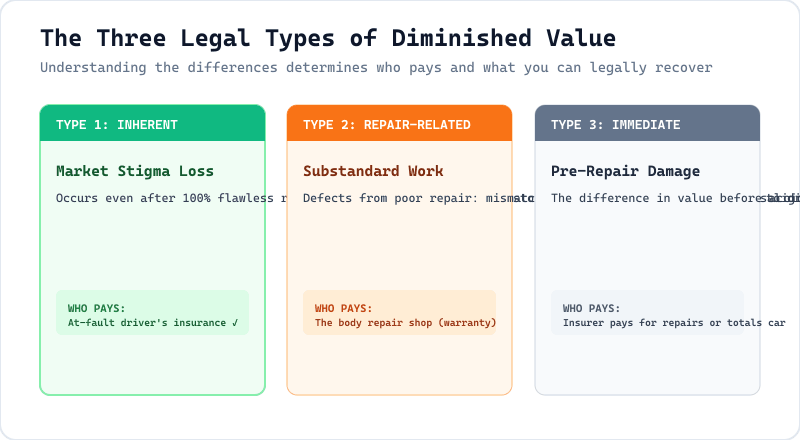
1. Inherent Diminished Value (Most Common)
The loss resulting strictly from market stigma. The car was repaired properly, but buyers demand a discount because of the accident record. This is the primary claim type paid out by insurance companies.
2. Repair-Related Diminished Value
Loss resulting from substandard workmanship — such as mismatched paint colors, overspray, misaligned panels, or poor welding. This is the legal responsibility of the repairing body shop under warranty, not the at-fault insurance carrier.
3. Immediate Diminished Value
The difference in market value immediately following the collision before any repairs have taken place. Rarely used except in total loss determinations or uncompleted repair disputes.
Is Filing a Diminished Value Claim Worth It?
Many accident victims wonder whether spending the time to pursue a claim is financially worth the hassle. The answer depends on three main variables:
When a Claim Is Usually Worth Pursuing:
- Newer Vehicles (Under 5–7 years old): Higher pre-accident actual cash value means potential DV recovery of $2,000 to $10,000+.
- Luxury & High-Demand Brands: Porsche, BMW, Mercedes, Audi, Tesla, Lexus, and high-trim trucks (F-150 Lightning, Silverado High Country) suffer the greatest percentage drops.
- Clear At-Fault Third Party: When the other driver was clearly cited by police, liability is undisputed, making property recovery straightforward.
- Substantial Repair Bills ($3,000+): Structural repairs or airbag deployment guarantee heavy resale penalty.
When It May Not Be Worth It:
- Vehicles Over 10–12 Years Old: High baseline depreciation leaves minimal remaining market margin.
- High Mileage (Over 100,000–120,000 miles): Insurers and buyers already price in high wear.
- Prior Major Accident History: If the vehicle already had two previous accidents on CARFAX, the marginal loss from this collision is minimal.
How Much Money Can You Actually Recover?
Many negotiated settlements and market comparisons fall in a broad band of roughly 10% to 25% of pre-accident market value, but your result depends on make, mileage, damage, and local comps. On a $30,000 car, that range is often $3,000–$7,500 — money you may otherwise absorb at trade-in if you never file.
Frequently Asked Questions
- What is the difference between inherent and repair-related diminished value?
- Inherent DV is stigma from accident history on a properly repaired car. Repair-related DV comes from poor workmanship and is typically pursued against the body shop, not the at-fault insurer.
- Does inherent diminished value show up on CARFAX?
- If the accident and repair were reported to insurers or DMVs, it usually appears on CARFAX, AutoCheck, or NMVTIS — which is what drives inherent DV in the resale market.
- Is inherent diminished value the same as depreciation?
- No. Normal depreciation is age and miles. Inherent DV is an extra buyer discount tied to accident history on top of ordinary depreciation.
- Who pays inherent diminished value?
- In many states you pursue it as a property damage claim against the at-fault driver's liability insurer. First-party coverage rules vary — check your state guide.
- How do I prove inherent diminished value?
- Pair pre-accident ACV sources (KBB, NADA, etc.) with comparable listings or appraisals showing clean-title vs accident-history prices, plus repair records and a written demand.
Sources & further reading
Statutes, claim rules, and settlement amounts depend on your state and facts. Use these references for methodology and history — not as legal advice.
Disclaimer: This content is for general consumer educational purposes only and does not constitute formal legal counsel. State laws vary.